Showing posts with label The Raven's Seal. Show all posts

Wednesday, August 7, 2019

Friday, September 18, 2015

Everywhere you go, you always take the weather with you

This is an intriguing review, of a book on the role of the weather in English arts and literature. I've always had a soft spot for literary atmosphere, from Dickens's fog and mud onwards. Readers of The Raven's Seal will know that winter and summer, snow, shine, and cloud, all have a role in that novel also. It's easy to mock the pathetic fallacy in fiction, but I find myself falling back on what you might call the soft pathetic fallacy. Setting, tone, atmosphere count heavily for a reader's sense of immersion, and weather bears on us and alters mood and perception in a singularly direct, sensory way. This is a vital tool in the descriptive writer's toolkit.

Of course, not every funeral takes place in the rain, and lovers don't always meet in storms or sunshine, but in A Hangman for Ghosts, the weight of the antipodean summer stands in for the oppressive machinery of the prison colony administration, while the bright light of the sun only serves to make the shadows of murder darker.

Thursday, September 25, 2014

Noted in passing: The Devil in the Marshalsea

A recent debut historical thriller, The Devil in the Marshalsea, by Antonia Hodgson, explores familiar terrain to The Raven's Seal.

Indeed, the promotional copy evokes some of the Dickensian themes that drive The Raven's Seal:
The Marshalsea Gaol is a world of its own, with simple rules: Those with family or friends who can lend them a little money may survive in relative comfort. Those with none will starve in squalor and disease.
I hope to have a chance to read it soon, but perhaps readers who have enjoyed The Raven's Seal and enjoy this will return the favour and bring The Raven's Seal to the attention of Hodgson's readership, as the pre-modern prison mystery seems set to gain more followers.

Wednesday, March 26, 2014

History, fiction, revelance

It's interesting, if disconcerting, to find oneself living in a state of Australia under an administration which seems intent on resurrecting regressive notions in criminal law that were part of the eighteenth century background to The Raven's Seal, or even my new work.

A writer is always on the hunt for new ideas, but this shows me that ideas of crime, law and punishment are always in flux, and that historical attitudes can find currency, and relevance, today. Hence historical fiction is not always about the dead past but instead a dialog between past and present, the character of ourselves as we were and as we are now. Sometimes, the past in fiction illuminates, as we glimpse of ourselves in the historical mist.

For example, the eighteenth century of The Raven's Seal was a period of great economic growth and upheaval: in many ways the foundation and apex of modern capitalism. But the cost of this growth was massive and growing inequality, a broad process of dispossession – an issue more than familiar to us today. In this case, as the few gain extraordinary wealth and the many lose prosperity and stability, I wanted to ask who the real criminals were: where was the invisible hand moving like a pick-pocket's, who could guide it, and who really grew wealthy at the expense of others? This mystery persists with us today, although the causes and policies that contribute to it are not particularly opaque, only the solution. What stands out from the eighteenth century experience is that though the markets are a game, they are by no means a neutral game: those who get to set the rules come to disproportionately reap the prizes, and at the same time label their play by the illusory name "fairness". In the case of The Raven's Seal, the codes of crime and punishment, privilege and service, were part of these rules.

We still live with the legacy and attitudes of the deep eighteenth century. In A Hangman for Ghosts, I'm interested in the "System" as a notion and a mystery, and the system of penal transportation which transplanted whole blocks of the "criminal classes" from one land to another. The task is to weave the story of crime and discovery around it. But as a character notes in The Raven's Seal, if you want to find who's guilty, first ask: "who profits?".
Wednesday, August 7, 2013

Worldbuilding and the maker's hand

Worldbuilding has been on my mind recently, following the AULLA Conference at The University of Queensland, this item on the '7 Deadly Sins of Worldbuilding' on io9.com, and my own efforts at shaping the world of my new novel, A Hangman for Ghosts.

Writers of speculative fiction are often positioned at the forefront of worldbuilding, encouraged to consider everything from consistency to tactile detail. The late Iain M. Banks was a masterful world builder because his worlds were vibrant, present and sturdy, and he could shift between them effortlessly. The Raven's Seal was also an effort in world-building for me, because the city and its society had characteristics that were critical to the mystery, but the true pleasure as a writer was to animate that world and make it feel like a lived experience rather than a static stage-set.

But as I argued recently in a paper at AULLA, I've come to suspect that worldbuilding in conformance to elaborate rules of procedure and solely in service of verisimilitude is in danger of making fictional worlds dull, prosaic, uninteresting even. Invented worlds can never be complete, and trying to catalogue all their features and account for all their internal mechanisms is a mere technical chore. The economy of Airenchester can't be found in micro-economics. The prison colony of A Hangman for Ghosts is not merely an administrative relic. Worlds come alive when we see them not as constructs, but as metaphors, figures, characters. This is something that Iain M. Banks understood implicitly, and this is what drew me to the complexities and wonder of worldbuilding in the first place.

Tuesday, July 9, 2013

A new review of The Raven's Seal

An excellent review of The Raven's Seal from novelist and reviewer Judith Starkston can be found on her blog. Starkston identifies some of the thematic and figurative elements of The Raven's Seal and describes them deftly (if I may say so).

Wednesday, May 22, 2013

Guest post on The Maiden's Court

There is a new guest post related to The Raven's Seal on The Maiden's Court, a blog dedicated to reviews of historical fiction and movies.

In this post, I take a closer look at the delicate matter of the relationship between Cassie and Grainger. The interesting thing for me about these posts is how they force even the author to look at their own work from a new angle.

Sunday, April 21, 2013

E-book Deal on The Raven's Seal

Although I can't say too often how impressed I am with the print production of The Raven's Seal, right now the e-book is on sale until Wednesday, April 24 for 0.99$ US.

You can find this deal on Amazon, iTunes for iBooks, Google and Kobo.

Even better, the deal has fired The Raven's Seal up to number 190 on the Kindle bestseller lists, and a brilliant #2 on the historical mysteries bestsellers list and the historical fiction list overall.

Tuesday, April 9, 2013

Cross-posting: Imagining Airenchester on Reading the Past

This week, I'm honoured that Reading the Past, a blog dedicated to news, views and reviews of historical fiction, has posted my short essay on imagining Airenchester, the broader fictional setting for The Raven's Seal.

In this piece, I speak to the creation of an imaginary city as the location for a historical fiction. What interests me most about this is how research and imaginations, and the techniques of world-building, can all lead into the creation of a fictional place that feels realised and is yet ephemeral.

Monday, March 11, 2013

ForeWord Reviews Book of the Year Finalist

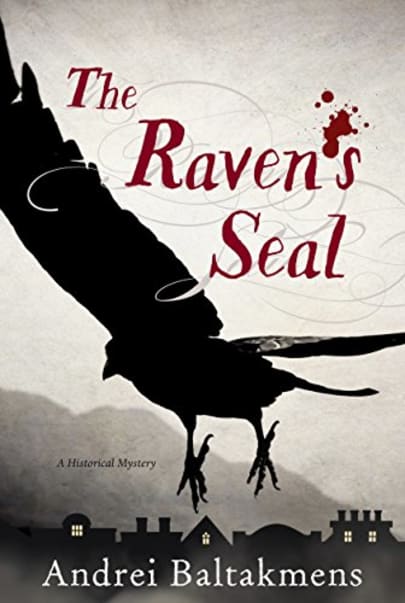
I'm delighted to learn that The Raven's Seal is a finalist for the ForeWord Reviews Book of the Year in the Historical (Adult Fiction) category. It's also a tribute, I think, to Top Five Books' book design.

Another reason, if I may, for readers to check out a copy, particularly the e-book edition if the print copy is out of reach.

Thursday, January 3, 2013

The End of Dickens's 200th

It's now the end of the bicentennial year of Dickens's birth: a great year for Dickens scholars and writers. As the next year starts, I can only speculate about how strangely Dickens's concerns come back to us in new forms, how poverty and need and the intransigence and short-sightedness of power - frequent themes and tensions in his work - recur with equal urgency two-hundred and one years later.

This year, I'm encouraged by the generous reviewers on Goodreads and the support of my readers to begin a new mystery. There will be a Dickensian link (perhaps subtly so), and a thematic connection to The Raven's Seal, but I am also inspired by some other favourite authors (Conrad in particular) and new experiences to move in an interesting direction.

Thursday, December 6, 2012

Cities and mysteries

A recent piece in The Guardian, London: fantasy's capital city, has me thinking about mystery, imagination and cities.

'Mystery is the doorway to fantasy' the writer remarks. Quite so, but then mystery is one of the basic wellsprings of plot and story, as Dickens so often demonstrated. When I wrote The Raven's Seal, I used one of the techniques of fantasy by making my setting, the city of Airenchester, wholly imaginary. In this way, it was the ideal stage on which arrange and play out my mystery.

The urban mystery, the attempt to pose the reality of the city as a mystery and then unpick it, is one of the oldest forms of mystery. I've always been attracted to cities of the imagination, from Italo Calvino's Venice to M. John Harrison's eerie and unforgettable Viriconium.

'Mystery is also the doorway to reality,' the writer concludes. Airenchester has always been a character in The Raven's Seal, as vividly drawn and present. I hope that Airenchester's fictionality, its fantasy, also tempts the reader to look behind the facade and imagine the mechanisms, the subterfuges, social forms, expectations, dreams and ideologies that drive and support it.

Thursday, November 15, 2012

Literary names and updates

I was thinking recently that someone ought to, if there wasn't already, make a study of the function of names in literature. In an odd instance of synchronicity, it seems that that book is here: Literary Names: Personal Names in English Literature by Alastair Fowler, reviewed in the London Review of Books (linked).

Several readers have noticed that I take a suggestive or descriptive approach to names in The Raven's Seal. This is not just a Dickensian technique, though Dickens was a master namer, but a way to tag or expose something about a character that can be wonderfully evocative. In fact, there are several buried clues to character in The Raven's Seal that I'm waiting for an astute reader to notice, but even if they remain unseen, they add something to the texture and sense of a character.

There is a very warm review of The Raven's Seal on the historical novels society site, and in this guest post for the Historical Fiction Society I write a little about composing The Raven's Seal and the way historical details were brought into and shaped the story.

Tuesday, September 25, 2012

New Reviews for The Raven's Seal

It's great to see a several really positive early reader reviews of The Raven's Seal over on LibraryThing.

This is particularly heartening because The Raven's Seal was intended as an entertainment, a text that would be readable, enjoyable even, and the reviewers seem to respond to this.

Thursday, September 13, 2012

An Actual, Authentic Review

Given the uproar over 'sock-puppet' - may we say 'author-led' - reviews, reported in The Guardian and duly repeated over here by the Brisbane Times, it's nice to see an actual, authentic early review of The Raven's Seal on LibraryThing this morning.

It's a very encouraging review, extremely positive overall, and close to what I wanted for readers. And a little criticism means that it's a balanced review as well. Will it come to pass that the trustworthy reviews will have to be salted with a little criticism, just to seem real?

Wednesday, September 5, 2012

The Author's e-Book

I've had a chance to look through the e-book (preview copy only) of The Raven's Seal. It's a wonderful, strange thing for the author to hold his or her own book in electronic form. It's a file, no more or less than the words you wrote. It's ephemeral, but then, aren't the words what really counts?

The e-book version looks great, like all of Top Five Books' work. The font is elegant, with a slightly old-fashioned feel, and the page looks wonderful, especially in portrait. Of course, I think the print copies will feel even better, and there is something about the materiality of the printed page that still holds us, through memory or association.

Yet, I'm reminded of the light, almost onion-skin paper of the compact editions of Dickens I first read at home, and how the electronic page in iBooks (or Kindle) almost duplicates that lightness, and comes closer to the book that Borges speculated about: infinite pages of infinite thinness.

Tuesday, August 21, 2012

The ‘Dickensian’ and The Raven’s Seal


Novelist Martin Amis, interviewed in the Chicago Tribune, acknowledges a Dickensian influence on his new novel, Lionel Asbo: State of England.

Amis says Dickens ‘isn't really a realist. Accurate social criticism is not his great strength; his great strengths are exaggeration and melodrama and comedy. It's a melodramatic form, the Dickensian novel — a magical transformation, with a sort of fairy-tale vocabulary or furniture behind this amazingly vivid picture of London....’

Amis’s comment had me thinking again about the Dickensian. To me, this word summons up not just the rich texturing of character and place and fairy-tale plots, but an extraordinary imaginative density and energy of style. Accuracy is not the point; the range of his sympathies, his irony, anger and penetrating humour are what makes Dickens' social criticism not only pointed but universal. 

This is what inspired me about using Dickens as a source for The Raven’s Seal. I aimed for a richness, and sometimes a complexity, of language that could create a lively sense of scene, which could be comic or melodramatic but never static. I wanted vivid characters rather than psychological portraits (although I hope that many of the characters are psychologically interesting). The prison was not only a Dickensian motif but an ideal setting for social criticism, still relevant because so much hinges on wealth and poverty, crime and punishment, the law and injustice, prisons and policing. And The Raven’s Seal is structured by at least a couple of Dickensian reversals of fortune which have that fairy-tale Romance flair about them. One of them, of course, is Grainger’s fall into the prison. The mystery hinges on the other. And the last thing I took from Dickens was a conviction that mystery need not just be a puzzle but the thematic core of a novel.

Friday, August 3, 2012

Coming in Fall 2012

More details of my forthcoming mystery novel, The Raven's Seal, are now featured on the publisher's website: Top Five Books. There's a sample from the opening and the back-cover blurb, here.

The cover design is great, but the sketch map of Airenchester (the fictional city where the story is set) is fantastic. More about mapping, imaginary spaces and The Raven's Seal soon.

Monday, April 23, 2012

Update - The Raven's Seal

My novel, The Raven's Seal, an historical mystery with a Dickensian edge, has been contracted for publication by Top Five Books, an independent publisher of quality mysteries and classics. Details to follow, after the manuscript is delivered.

Monday, January 31, 2011

I'm working on - The Raven's Seal

The Raven's Seal is the novel I've been working on since late 2004. In fact, the first few lines were written in the winter quiet of Uris Library, at Cornell University.
What is The Raven's Seal? It's an historical mystery, but it's a mystery in the Dickensian sense, in that the characters find themselves thrown into the centre of a mystery that they must navigate and survive as much as investigate.
It's set in the late-eighteenth century city of Airenchester (my own invention, in the tradition of Cloisterham), and in particular, in the precincts and surrounds of the Bellstrom Gaol, where the protagonist, Thaddeus Grainger, is falsely imprisoned for the murder of his rival.
For me as a writer, the device of the mystery, with more than a nod to the Victorian novel of urban mysteries, gives The Raven's Seal a more open, flexible form, encompassing the prison narrative and the novel of society. The mystery (I hope) is an experience, an entertainment, not simply an exercise in detection and deduction.